I have been doing a lot of listening over the past few months. I have been sitting with the stories of birth parents, foster parents, kinship caregivers, youth in care, caseworkers, CASAs, medical professionals, judges, attorneys, community leaders, faith communities, and more.
Some of what I am hearing is hard. Really hard.
Foster care is already difficult. Even when a child truly needs to be there, that reality does not make the experience easy. It is a little like needing to go to the dentist. You know it is necessary, but you are not circling the date on your calendar with excitement.
Unless you are like my son, who is thrilled about going to the dentist because he is finally getting his braces off. That appointment is a celebration. But most of the time, dental visits are not the highlight of anyone’s life.
Now imagine something that is already hard becoming even more painful because the people within the system do not do their jobs well or do not fully understand how their actions and inactions affect others. That is what I am hearing, and it is triggering.
I hear about foster parents who carefully fill out court reports, only to be told in open court that the judge is not reading them anyway.
For many foster parents, that report is their only voice in the courtroom. They might not be called to testify. They might not be invited to speak. That written report is how they share what is happening in their home and the daily life of the child in their care.
When you put in the time to describe your observations, your worries, and your insight into what a child needs, and then you find out no one is even looking at it, that hurts.
I also hear about caseworkers who are being spoken to as if they are less than human in court settings.
No one likes to be talked to as if they are beneath everyone else. Not in a courtroom, not at a job, not in a grocery store. We can disagree, correct, and hold people accountable while still treating them with basic respect.
I remember times in court when I would watch caseworkers get verbally attacked in front of everyone. Then they would walk out of the courtroom with this look in their eyes that said, “I did not sign up for this. I just wanted to help.”
When you feel like you are being abused by the very environment you are trying to serve, it becomes harder and harder to show up day after day.
The stories that weigh on me the most are about youth who are not given basic information or voice in their own cases.
Some older youth, 16 or 17 years old, are being told they do not need to attend court. That might sound like a relief at first, but it also means they are not present to hear what is being said about their life or to speak up for themselves.
Even more heartbreaking are the stories of youth who do not fully understand that they are in foster care or what that means.
Some have never met their guardian ad litem, the person who is supposed to be advocating for their best interest in court. The guardian ad litem shows up in court and speaks on their behalf, but the young person has never had a meaningful conversation with them.
Technically, it is not the youth’s job to chase down the guardian ad litem. The adult professional should be reaching out to the youth.
I remember a moment at my church when several families were serving as foster parents. There were always a few children in foster care visiting our services.
I walked up to one young lady and asked, “How are you?”
She said, “I am okay.”
I asked, “How is your placement going? Do you need anything?”
She looked at me and asked, “Where am I?”
I thought she meant the name of the church, so I said, “You are at Grace Tabernacle.”
She looked at me again and said, “No. Where am I? What city am I in? Am I still in Kansas?”
She was genuinely confused about where she was and about her surroundings.
Imagine being a child thrust into foster care, where everything you thought you knew is suddenly different. The people, the rules, the location, even the sense of home. It is unsettling in ways that are hard to put into words.
We cannot assume that youth understand what foster care is, or what it means for their life. We have to take the time to explain, to answer questions, and to revisit those conversations as things change.
Have you ever joined a movie or a television series halfway through and spent the rest of the time trying to figure out what is going on?
You might whisper to the person next to you, “What happened before this scene?” They shush you because they are trying to watch too.
That is what it often feels like for families, new workers, and volunteers entering the child welfare system.
They are walking into the middle of the movie with:
Yet we expect them to understand quickly, get it right, and not to ask “too many” questions.
This is one reason I am so grateful for healthy, engaged church communities.
Our church family, and many church families across the nation, function as both prevention and support. They are often the people who:
My husband and I have four children who are 14, 15, 16, and 17. At one point, that meant we had a newborn, a one year old, a two year old, and a three year old.
We chose to have our children close in age, and I had this personal goal of being done having kids by 30. That part worked out, praise God. But that did not mean it was easy.
There were Sundays when I would walk into our church sanctuary exhausted and stretched thin. My husband had many responsibilities in the church. Yet family and church members would swoop in, pick up the babies, and give me a moment to breathe and reset.
That was not a program. That was not a grant funded service. That was community.
This is the kind of natural support that can keep families stable and resilient. Church families, neighbors, mentors, and extended family can all play that role when it is safe and healthy to do so.
Whenever I have a strong emotional reaction to something, I take that as a sign that I am called to do something in that space.
If you are reading this and there is something in you that keeps asking, “Why are we not doing this better” that might be your call too.
When a child is removed from the home, it’s too important for families and for the people who serve them to be left without clarity and connection.
You can take the 360º Partnership Assessment at www.syncingchildwelfare.com.
Use it with your organization, your church, your agency, your neighborhood watch group, or your collaborative group as a starting point for change.
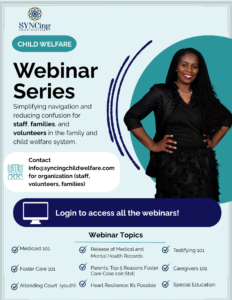
When you are ready to take the next step- we have a great webinar series for you to dive into. Email for access: info@syncingchildwelfare.com.
Over the past few months, I’ve been listening to parents, youth, foster/kin caregivers, caseworkers, and partners. The stories are heavy: reports not read, workers shamed, youth told to skip court, or not even told where they are. These moments are triggering because they disconnect people who are already carrying so much.
I asked a colleague, “Do you even think this is possible?” because every idea was met with reasons it wouldn’t work. That same mindset creeps into child welfare. We call foster care and CPS broken, then keep doing the same training and processes… and get the same results
This week, I reflect on how faith and community reframe child welfare from “go do it alone” to “you are surrounded.” We walk through prevention (keeping families out of foster care), support (sustaining them after formal help ends), and practical steps to activate natural supports now.